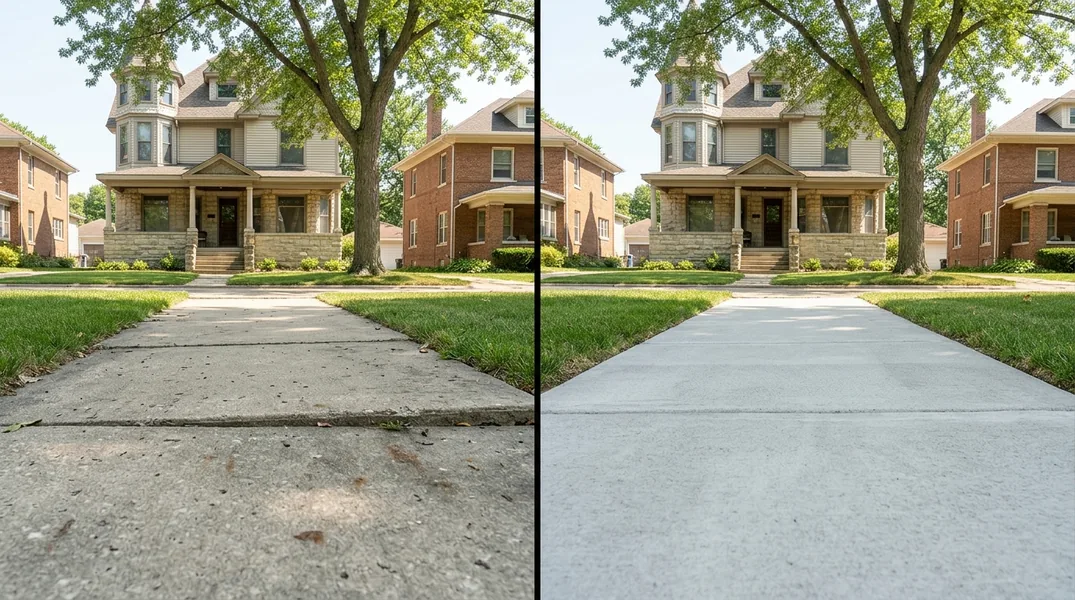
Understanding Elgin's Unique Soil Composition
If you own a home or business in Elgin, you've likely noticed that concrete doesn't age the same way it does in other parts of the country. The culprit isn't poor installation or substandard materials, but rather the geological legacy of the region itself. Elgin sits on terrain shaped by glaciers that retreated thousands of years ago, leaving behind a complex foundation of glacial clay, river gravel, and fine sediments that create perfect conditions for concrete distress.
Glacial clay is particularly problematic for concrete longevity. This dense, fine-grained soil holds water exceptionally well, which means moisture doesn't drain away quickly from beneath your driveway or patio. When water becomes trapped under concrete, it creates hydrostatic pressure that pushes upward against the slab. Over time, this pressure weakens the bond between the concrete and its base, leading to heaving, cracking, and eventually structural failure. The river gravel mixed throughout the soil profile adds another layer of complexity, as these stones shift and settle unevenly when saturated, creating an unstable foundation that amplifies concrete movement.
The Freeze-Thaw Cycle and Illinois Winter Damage
The most destructive force working against concrete in Illinois is the relentless freeze-thaw cycle that occurs every winter. Elgin experiences temperatures that regularly dip below freezing for extended periods, and when moisture trapped in soil and concrete freezes, it expands. This expansion is powerful enough to lift entire concrete slabs, a phenomenon known as frost heave. Homeowners often wake up in January or February to find their once-level driveway now has a noticeable hump or their patio has shifted several inches.
What makes freeze-thaw damage particularly insidious is that it's cumulative. Each winter cycle causes additional micro-fractures and stress within the concrete matrix. Water penetrates these tiny cracks, freezes, expands, and widens the damage. By the time you notice visible cracking or major heaving, years of this invisible damage have already compromised the structural integrity of your concrete. Illinois winters are long enough and cold enough that this cycle repeats dozens of times each season, making it one of the most aggressive environmental stressors concrete can face in North America.
Why Frost Heave Happens Differently in Elgin
Frost heave in Elgin is more severe than in regions with sandy or well-draining soils because of how glacial clay interacts with freezing temperatures. Clay particles are extremely fine, almost powder-like, and they hold water in pores that remain saturated throughout the winter. When these pores freeze, the water doesn't just expand in place, it draws additional moisture from surrounding soil through a process called ice lens formation. This creates layers of pure ice that can grow to several inches thick beneath your concrete, literally lifting the slab upward.
The problem is compounded by the depth of frost penetration in Illinois. The frost line in this region extends 42 to 48 inches below the surface, which means that ice formation can occur well below the depth of a typical residential concrete installation. If your Concrete Driveways were installed without proper base preparation or adequate drainage, the frost line will eventually reach the soil directly beneath your slab, causing heaving that can crack even well-constructed concrete. This is why proper site preparation and drainage design are absolutely critical for any concrete project in the area.
Common Concrete Cracking Patterns in Elgin Soil
Homeowners in Elgin often recognize concrete damage by specific cracking patterns that are characteristic of soil-related stress. Linear cracks that run perpendicular to the direction of the slab are typically caused by frost heave pushing the concrete upward. Diagonal or stair-step cracks, particularly in basement walls or foundation slabs, indicate differential settling where one portion of the foundation has moved more than an adjacent section. Spider web or map cracking, where many small cracks radiate outward from a central point, usually results from water saturation in the subgrade combined with freeze-thaw stress.
The reality is that Elgin's soil composition makes it nearly impossible to prevent all concrete cracking entirely. However, the severity and rate of damage can be dramatically reduced through proper design, installation, and maintenance. This is why it's essential to work with concrete professionals who understand the specific challenges of the local soil and climate. If you're seeing significant cracking or heaving in your existing concrete, contact Elgin Concrete for a free estimate to assess whether Concrete Repair & Resurfacing can extend the life of your installation or if replacement is the better long-term solution.
Prevention and Proper Installation for Elgin Conditions
The best defense against soil-related concrete damage is prevention through proper installation techniques that account for local conditions. This means starting with a comprehensive site evaluation to understand the soil composition, drainage patterns, and frost depth. A qualified concrete contractor should then specify an appropriate base layer, typically four to six inches of compacted gravel that allows water to drain away from the concrete rather than accumulating beneath it. Proper slope and grading are equally important, ensuring that surface water runs away from the slab rather than pooling at the edges where it can infiltrate the base.
For new Concrete Driveways or Concrete Patios in Elgin, specifying a concrete mix that's specifically designed for freeze-thaw exposure makes a significant difference. Air-entrained concrete, which contains tiny intentional air bubbles, provides space for water to expand without cracking the surrounding concrete. The concrete should also be sealed after installation to reduce water penetration, and this seal should be reapplied every two to three years to maintain protection.
When to Call a Professional for Concrete Repair Near Me
If your concrete is already showing signs of damage from Elgin soil conditions, the time to act is now. Small cracks less than one-eighth inch wide can often be sealed to prevent water infiltration and slow further deterioration. Larger cracks, heaving, or displacement typically require more comprehensive repair or replacement. The key is addressing problems early, before minor issues cascade into major structural concerns that become exponentially more expensive to fix.
Concrete Repair & Resurfacing specialists can evaluate your specific situation and recommend the most cost-effective solution. Some concrete can be releveled using polyurethane injection or mudjacking techniques, while other situations call for removal and replacement. Call Elgin Concrete at (224) 268-1462 today to schedule an inspection and learn what options make sense for your property. Our team understands the unique challenges posed by glacial clay, river gravel, and deep frost cycles, and we design solutions that hold up to Elgin's demanding climate.
Looking for a professional concrete contractor in Elgin? Elgin Concrete responds fast for all your concrete needs.
Get a Free QuoteOur services: Concrete Driveways · Concrete Patios · Stamped & Decorative Concrete